


 +44 (0)1455 848 411


Ghosts in the Blur: Crafting Sound of Falling with TLS Cooke Speed Panchros
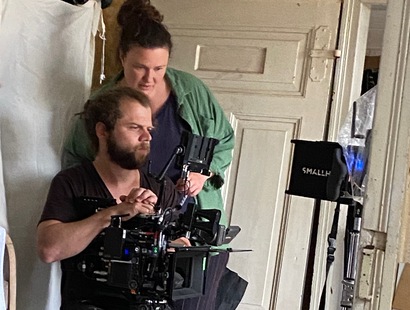
Fabian Gamper has become known for his atmospheric and emotionally textured visual style. He recently won the German Camera Award 2026 and received Gold for Best Cinematography at the German Film Awards 2026.
His latest feature, Sound of Falling by Mascha Schilinski, premiered in competition at the 2025 Cannes Film Festival, where it received the Jury Prize. For his work, Fabian Gamper received the Silver Frog at EnergaCAMERIMAGE and the Bavarian Film Award for Best Cinematography.
A film built from memory, not plot
For cinematographer Fabian Gamper, Sound of Falling didn’t begin with a conventional production process. It began much earlier, in conversations, ideas, and breakfast-table discussions with director and co-writer Mascha Schilinski, who is also his wife.

Fabian was involved from the very first idea stage. While he did not take part in writing the script, he and Mascha were constantly talking about it as it developed alongside co-writer Louise Peter. Together, they were drawn to questions that are difficult to translate into narrative form, particularly ideas like “what has been inscribed in our bodies, even before we were born?”
The abandoned farmhouse at the center of the film became the anchor for these themes. It holds an entire century of stories across four time periods, all unfolding in and around a single location. Instead of following a traditional structure, the film moves associatively and fragmentarily through space and time, more like memory than storytelling.
Finding an “inner image”
From the beginning, the visual question was not “how does this look?” but “how does this feel when remembered?”. Fabian and Mascha wanted images that felt like inner images, impressions that sit just out of reach, like memories you can’t fully access anymore.
A key reference was the work of photographer Francesca Woodman. Her photographs carry a ghost-like quality that deeply resonated with both of them. Motion, blur, disappearance, all became part of the visual thinking. Fabian experimented with motion blur and abstraction, but quickly found that traditional approaches didn’t translate directly into moving images. So he began testing alternatives: pinhole optics, modified vintage still lenses, and other optical effects that could introduce softness and uncertainty into the image.
At one point, the team seriously considered shooting the entire film through a pinhole lens. But that idea ultimately went too far. It created too much abstraction and began to break the connection to performance. Instead, those effects were reserved for specific moments, while the search continued for a main lens system that could hold the emotional world of the film.
Choosing the TLS Cooke Speed Panchros
That search eventually led to the TLS Cooke Speed Panchros. For Fabian, the decision came down to something less technical and more emotional: the quality of the blur. During lens tests, he placed subjects in the foreground with vegetation behind them, leaves, trees, natural textures dissolving into the background. Compared to modern lenses, which tend to render out-of-focus areas in a smooth and uniform way, the Cooke Speed Panchros behaved differently. The bokeh felt less controlled. Less predictable. Almost unstable in a living way.
Fabian described it like this:
“Compared to modern lenses, where the bokeh is more homogeneous, the Cooke Speed Panchros create a unique bokeh I find somewhat mysterious. It’s a little harder to make out what’s actually there in the blur, it seems to be somehow alive. It felt to us as if a ghost from another time could be lurking in the blur at any moment.”
That quality fit perfectly with the film’s world, a space where time layers itself and memory never fully settles.
Shooting digital, thinking in film
The production would have preferred to shoot on 16mm film, but budget constraints made that impossible. Instead, the film was shot primarily on an ARRI Alexa Mini. To recover some of the lost texture of film, grain, halation, and softness were added in post-production, but the Cooke Speed Panchros already carried part of that emotional softness in-camera. They helped bridge the gap between digital capture and the filmic feeling the team was chasing.
Lenses that support movement
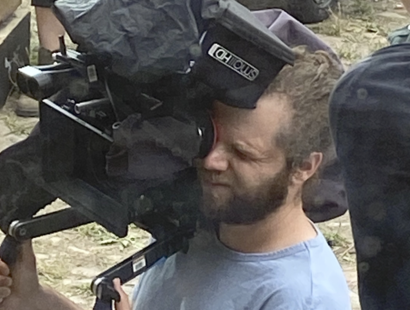
The shoot itself was physically demanding, often using Steadicam and handheld work to move fluidly through time periods, rooms, and emotional states. Fabian often operated the Steadicam himself using a lightweight rig, which made lens weight an important factor. The TLS rehoused Cooke Speed Panchros turned out to be a perfect match. They were light enough for extended handheld and Steadicam use, but still carried the character the film needed.
At the same time, 1st AC Christian Öhl worked with a motorised remote focus system for much of the production. Despite their vintage optical origins, the rehoused lenses performed with remarkable smoothness. Fabian summed it up simply:
“The TLS rehoused lenses worked perfectly from a technical standpoint. The smooth-running cam-driven focus system was ideal, it felt like shooting with modern lenses.”
An unexpected discovery with the FX6
The production primarily used a 4:3 aspect ratio, working with both the Alexa Mini and a Sony FX6, chosen for its low-light capabilities in night scenes and effect shots. Originally, the Cooke Speed Panchros were only intended for the Alexa Mini, since the FX6 has a full-frame sensor that raised coverage concerns. But something unexpected emerged during testing. Once the image was cropped to 4:3, the film’s final format, the lenses suddenly covered the FX6’s sensor far more effectively than anticipated. Fabian explained:
“I actually only intended to use the Cooke Speed Panchros for the Alexa, but then I realized that the lenses can illuminate the FX6’s LF sensor if you crop the image to 4:3, which was our final aspect ratio. So we ended up using the Cookes on the FX6 for some scenes as well.”
The discovery quietly expanded the flexibility of the production without changing its visual language.
Continuing the collaboration
For Fabian Gamper, the relationship with the TLS rehoused Cooke Speed Panchros didn’t end when Sound of Falling wrapped. He has already returned to the same lenses for his next project, Echo of Tomorrow’s War by Nicolas Ehret.
Discover More
You can find out more about Fabian Gamper on his website (https://www.fabiangamper.com/) or instagram page: @fabiangamper
Discover how a TLS rehousing can unlock the full creative potential of your vintage lenses. Contact us on +44 (0) 1455 848 411 or Sales@truelens.co.uk


